
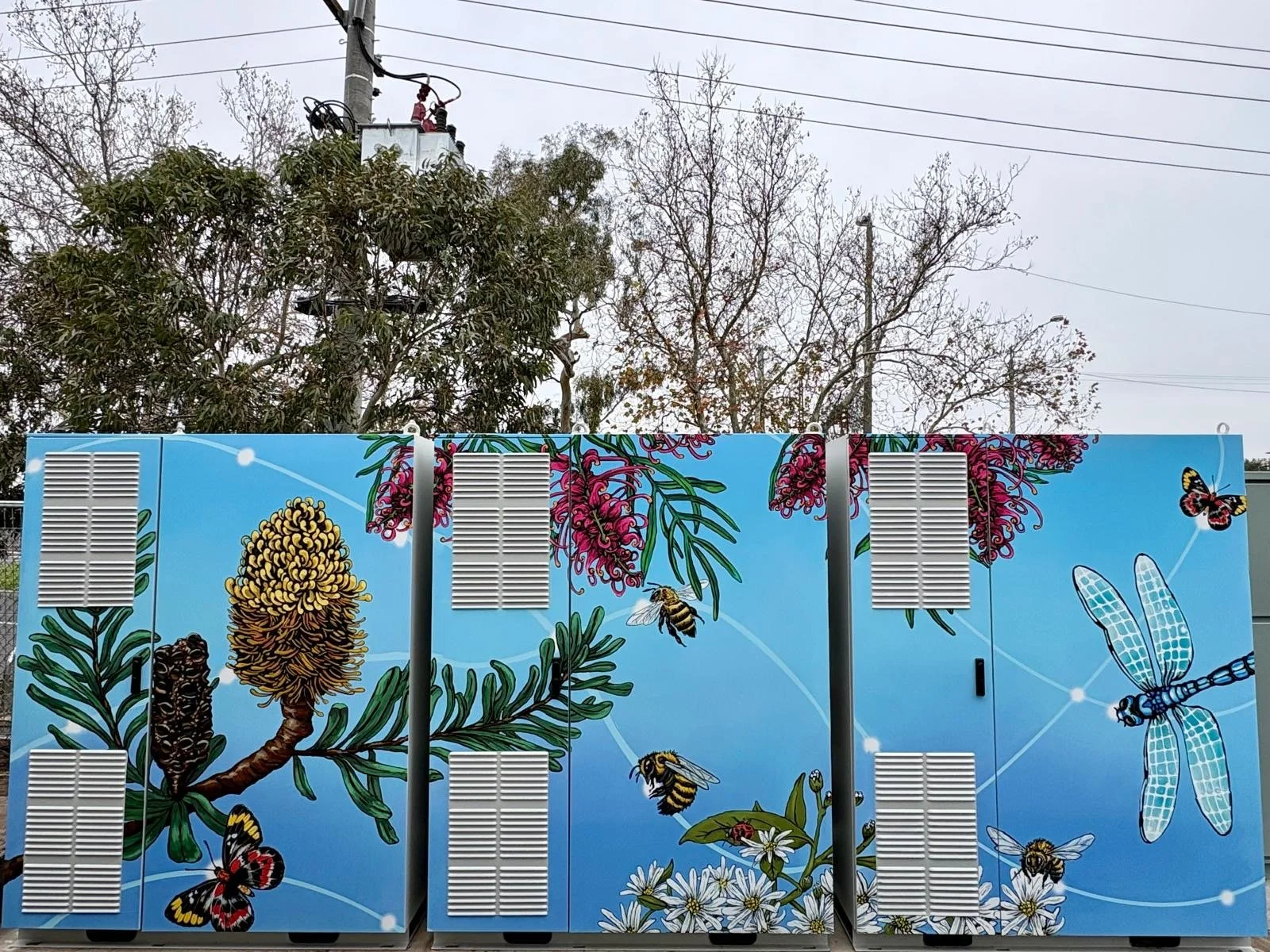
Alphington Community Battery
On 27 June 2026, Village Power launched the Alphington Community Battery and Community Energy Program, the result of eight years of volunteer-led work and a landmark moment for community-owned renewable energy in Victoria.
Funded by the Victorian Government's Neighbourhood Battery Initiative and built in partnership with Acacia Energy, the battery stores surplus solar energy generated by local rooftops during the day and releases it into the neighbourhood network during the evening peak — when demand is highest and the grid still relies heavily on fossil fuels.
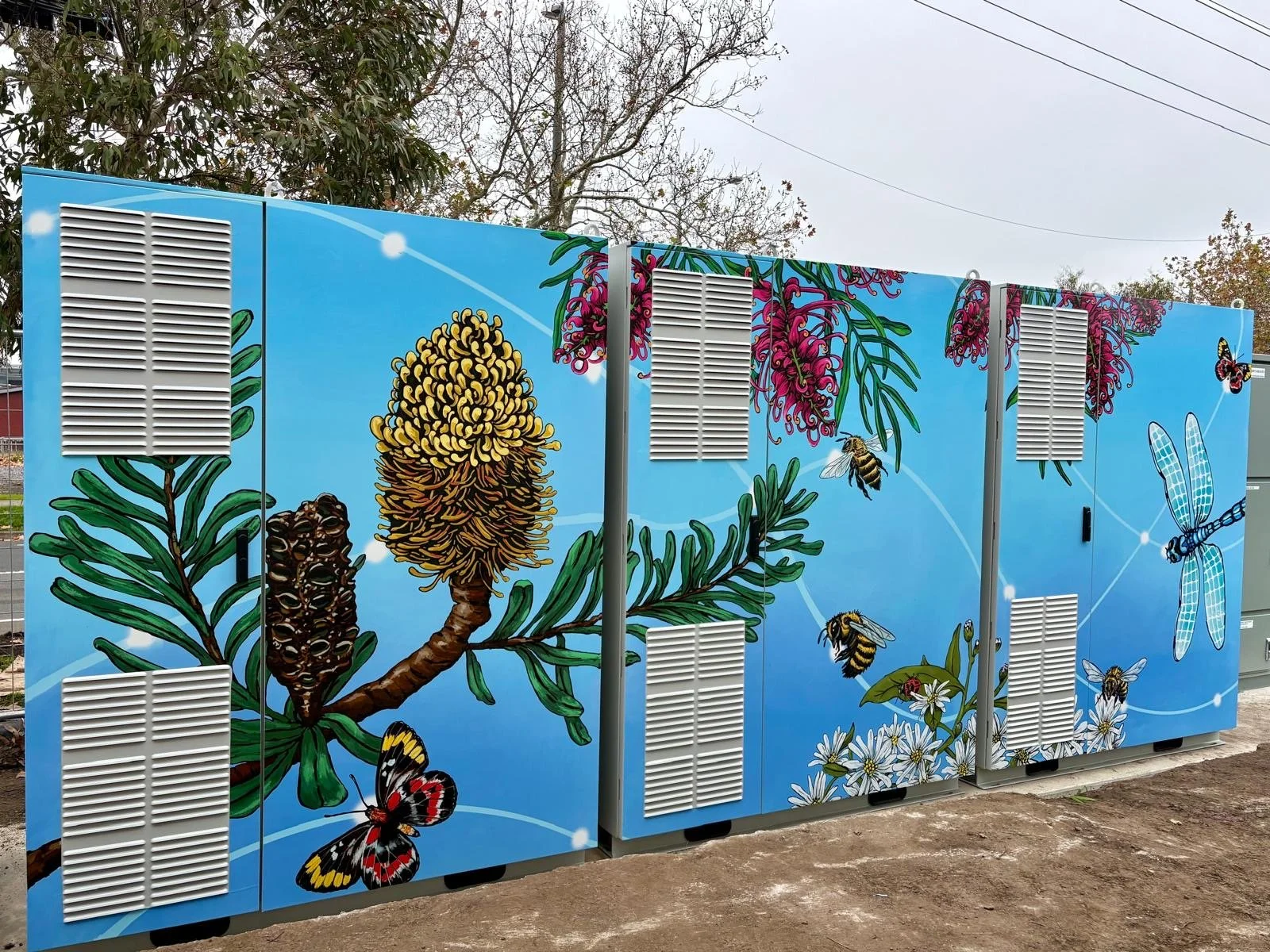
‘A Hidden Network of Community Power’
Artwork by Jo Travis, 2027
This artwork transforms the community battery into a living energy network, where native insects and plants visualise the power of many small contributions working together. By making invisible energy systems visible, it celebrates collective action and a shared renewable future.
Jo was the final artist selected from a community art competition held by Village Power. Artists needed to submit a proposal for a design to wrap the battery, responding to themes of community, renewable energy, and the relationship with the natural environment in Alphington-Fairfield. The artwork was made possible through funding from Community Bank East Ivanhoe, Bendigo Bank.
Village Power acknowledges and is grateful for funding and assistance from:

The Victorian Government through the Neighbourhood Battery Initiative’s funding of Village Power: Putting the Community into Alphington’s Community Battery project.

Community Bank East Ivanhoe, Bendigo Bank’s funding of the battery artwork

Acacia Energy, our delivery and operational partner

Darebin City Council, for the land lease
And to the community, for their ongoing encouragement and support.
Battery specs
The Alphington Community Battery is a 200 kW/645 kWh battery energy storage system installed at the Melbourne Farmers Market site on Wingrove Street, Alphington. It connects to the Jemena low-voltage distribution network that serves the local area.
On the site there are three air-cooled battery energy storage systems (BESS) and a control panel. The three BESS together are rated as 315 kW / 645 kWh, but the grid connection limits this to 200 kW / 645 kWh. This means they can store up to 645 kWh of energy and deliver 200 kW of power. The battery models are Potis Edge OmniCube-A215 BESS.
The Community Energy Program
The Community Energy Program is the mechanism that connects local households to the Alphington Community Battery. Launched in April 2026, it runs for five years and is open to all residents of the Alphington and Fairfield Electricity Zone — including renters, apartment dwellers, and households without rooftop solar.
The program has two parts. The first is education: helping participants build their energy literacy, from reading their own bills to understanding how solar is generated, used, and stored in the neighbourhood. The second is behaviour change: working with participants to shift energy use toward times when local renewable supply is greatest, reducing reliance on fossil fuels day to day.
Village Power has also introduced a new measure of Community Energy use — tracking how much local demand is met by locally generated power. Based on the principle that you can't improve what you don't measure, the program establishes a baseline and sets a shared challenge to improve on it over time.
What's involved for participants:
Around one hour per month engaging with workshops and resources
Occasional community events to meet other participants and share learnings
Short surveys to help improve and report on the program
Anonymised energy data (with permission) used to build a picture of community energy use each season
What participants receive:
Seasonal reports on their own household energy use
Practical tips to reduce bills and carbon footprint
Coaching and community events to help shift energy use toward times of greater local renewable supply
An annual financial incentive drawn from the battery's operating revenue
The program currently has 48 households and is growing to 100. Find out more and express your interest →
Community Engagement
Village Power has been part of the Alphington and Fairfield community since 2018. From the earliest conversations to the battery's commissioning in June 2026, local residents have been central to every stage of the project.
The first cohort of 48 program participants reflects the diversity of the neighbourhood: three quarters have rooftop solar (some for over a decade), while a quarter — mostly renters and apartment residents — have no clean energy systems at all. For that group, the Village Power model is the only realistic way to access the benefits of locally generated renewable energy.
Ninety-four percent of participants said they would engage with the monthly materials. When asked what drew them to the program, they spoke of community, learning, energy independence, and climate action.
"Local systems not only make good sense for energy saving, they are good for social cohesion." — Community Energy Program participant
"We think community batteries are a great way of ensuring everyone has access to cleaner power." — Community Energy Program participant
FAQ
-
The Alphington Community Battery was funded through the Victorian Government's Neighbourhood Battery Initiative. Village Power's objectives for the project are to:
Store surplus local solar energy during the day and release it during the evening peak
Make the benefits of locally generated renewable energy available to all households in the area — not only those with rooftop solar
Measure community energy use and establish a shared target to increase it over time
Demonstrate that a community-led energy model is financially viable and replicable
Support the decarbonisation of the local electricity network
Build energy literacy and behaviour change across the community
Share openly everything learned — including what didn't work — so other communities can follow a shorter path
-
The Alphington Community Battery is installed at the Melbourne Farmers Market site, 2 Wingrove Street, Alphington. The site is on land leased by Darebin City Council, whose support was instrumental in securing it.
-
The Alphington Community Battery is a 200 kW / 645 kWh battery energy storage system. It connects to the Jemena low-voltage distribution network that serves the local area.
-
Village Power partnered with Acacia Energy, a licensed energy company, to own and operate the battery. Village Power receives a revenue share and retains full leadership of the Community Energy Program. This arrangement emerged after Village Power encountered significant barriers to direct community ownership — including the absence of suitable insurance products for community-owned grid-scale batteries in Australia and a retail market that did not yet accommodate community models. Documenting these barriers, and advocating for the regulatory changes needed to address them, is one of Village Power's most significant contributions to the sector.
-
Acacia Energy uses an arrangement called a Peak Swap to generate revenue from the battery's operation. Rather than depending on fluctuating market prices, the Peak Swap locks in a steady, agreed return for the battery's evening output. Acacia shares a portion of this revenue with Village Power, which uses it to fund the Community Energy Program and distribute an annual payment to active participants.
-
No. The Community Energy Program is open to all households in the Alphington and Fairfield Electricity Zone, including renters, apartment dwellers, and households without solar. Increasing access to the benefits of locally generated renewable energy for people who have been left out of the rooftop-by-rooftop model is central to Village Power's mission.
-
No. Solar households will continue to receive their existing feed-in tariff when they export surplus energy to the grid. The community battery operates independently of that arrangement.
-
There are two aspects that set the Alphington Community Battery apart. The first is the Community Energy Program: a structured, long-term education and behaviour change program that connects households directly to the battery and measures the community's use of locally generated renewable energy. The second is Village Power's commitment to replicability — from the beginning, the goal has been to build a proven model, document everything learned, and make it freely available to communities anywhere in Australia who want to do the same.
-
Yes — that has been the goal from day one. Village Power is openly sharing everything it has learned: what worked, what didn't, the regulatory barriers encountered, and the practical requirements for communities starting out. Resources and documented learnings are available at villagepower.com.au.
-
If you live in the Alphington and Fairfield Electricity Zone, visit villagepower.com.au to check your eligibility and express interest in joining the Community Energy Program.
If you are part of a community group, local council, or neighbourhood network elsewhere in Australia and want to explore starting your own community energy project, Village Power would love to hear from you. Contact the team at info@villagepower.com.au.
Visit the battery
The Alphington Community Battery is located at the Melbourne Farmers Market, 2 Wingrove Street, Alphington.
Everyone is welcome to visit the battery and take in the artwork that wraps its exterior. If you or your organisation would like to know more, get in touch at info@villagepower.com.au.
About Village Power
Village Power is a community-owned incorporated association founded in 2018. It has no paid staff. Its board is made up of volunteers from Alphington, Fairfield and Ivanhoe, united by a shared conviction that communities have an essential role in the clean energy transition.
Get in touch
info@villagepower.com.au
Search for Village Power on Facebook or Instagram
The artwork
The artwork wrapping the Alphington Community Battery was created by local artist Jo Travis and is titled A Hidden Network of Community Power.
The design turns the battery into a living garden. Native plants found around the area — Rosemary Grevillea, Silver Banksia, Snow Daisy Bush — spread across its surface, buzzing with bees, butterflies, ladybirds and dragonflies. Fine flowing lines connect them, tracing both the paths of pollinating insects and the unseen movement of shared solar energy through the neighbourhood. The dragonflies even have solar panels for wings.
Each creature is small and easy to miss, but together they keep a whole ecosystem alive. It is a picture of community energy itself: many small contributions adding up to something far larger than any one of them alone. By making an invisible energy system visible, the artwork is a reminder that everyday actions can add up to real change.
The artwork was made possible through funding from Community Bank East Ivanhoe, Bendigo Bank.

Opportunity details
CLOSING DATE
March 6, 2026
Applications now closed
ACCEPTING APPLICATIONS FROM
Applicants who live, work, or have a connection to the City of Darebin
ARTFORM
Visual Arts